
Guides
How Exchange Withdrawal Fees Actually Work — and How to Pay Less (2026)
Withdrawal fees are set by the exchange and are usually flat per network, not a percentage — which changes how you should batch and route transfers.
Published: September 2026 · By the bsvar editorial team
Short answer: the fee you pay to withdraw crypto is set by the exchange, not by the blockchain — and it is usually a flat amount per network, not a percentage. That single fact drives every way of paying less: choose a cheaper network, withdraw less often in larger amounts, and never move a small balance across an expensive chain.
Ignore any specific fee figure you read in a guide, including this one. Fees change per platform, per coin, per network and over time. The live number on your withdrawal screen is the only one that is true.
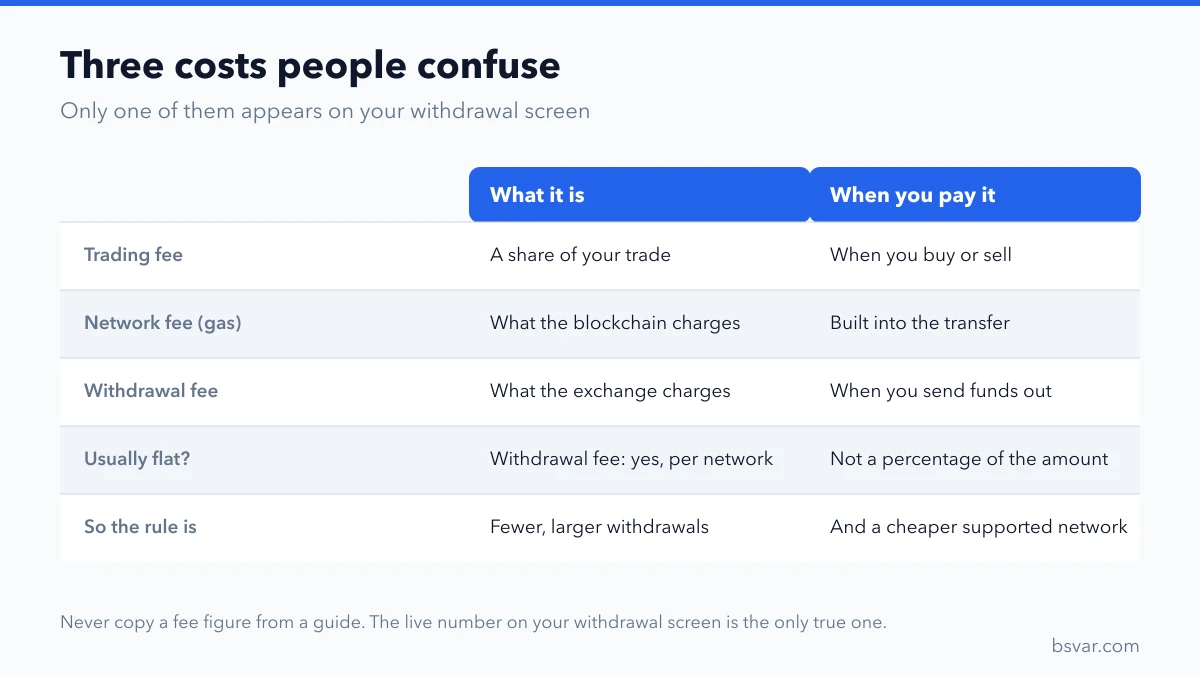
The three costs people confuse
1. The trading fee. Charged when you buy or sell, usually a percentage of the trade. Nothing to do with withdrawing.
2. The network fee (gas). What the blockchain itself charges to process a transaction. On Ethereum this floats with demand; on Tron it is generally low and stable.
3. The withdrawal fee. What the exchange charges you to send funds out. This is the one on your withdrawal screen, and it is usually a fixed amount of the coin being withdrawn — not a percentage of the amount.
Point 3 is where the confusion lives. The exchange's withdrawal fee is related to network costs, because the exchange pays those, but it is not the same number. Platforms set a flat fee that averages out their costs, adjust it periodically, and may profit or lose on any individual transaction.
Why a flat fee changes your strategy
If the fee is a fixed amount, then the percentage you lose depends entirely on how much you send:
| Withdrawal size | Effective cost of the same flat fee |
|---|---|
| Small | A large share of the amount |
| Medium | Noticeable but tolerable |
| Large | Almost negligible in percentage terms |
The practical rules follow directly:
- Batch your withdrawals. One transfer of a larger amount costs one fee. Four transfers cost four fees, regardless of size.
- Never withdraw dust across an expensive network. The fee can approach or exceed the value.
- Check the minimum withdrawal. Below it, the transfer is simply rejected — and a minimum is not the same as a fee.
Where the real savings are: the network
For a stablecoin like USDT, the same token exists on several networks, and the withdrawal fee usually differs sharply between them. Choosing the network is normally worth far more than any other optimisation available to you.
But the constraint comes first: the receiving side has to support the network you pick. A cheap withdrawal to a network the recipient does not accept is not a saving, it is a loss. Read TRC20 vs ERC20 USDT: Which One Should You Choose? before optimising for cost.
Order of operations that actually works:
- Check which networks the recipient supports.
- Of those, compare the live withdrawal fee on your sending platform.
- Pick the cheapest supported option.
- Confirm the minimum withdrawal and any memo requirement.
- Send.
Legitimate ways to pay less
- Withdraw less often, in larger amounts. The highest-impact change for most people.
- Use a cheaper supported network. The second highest.
- Withdraw the stablecoin rather than converting. Converting to another asset first adds a trading fee and spread on top of the withdrawal fee.
- Check whether internal transfers are free. Moving funds between two accounts on the same platform usually costs nothing, because it never touches a blockchain. If your recipient uses the same exchange, this can be free.
- Compare platforms before you fund. Withdrawal fees differ meaningfully between exchanges for the same coin and network. This matters more than a small difference in trading fees if you withdraw regularly.
- Check fee-discount programmes if you use one exchange heavily. Terms vary and change; read the current rules rather than a summary.
- Time Ethereum withdrawals if you must use ERC20 and the platform passes through variable gas. Network demand fluctuates.
What does not work
- Waiting for the fee to drop on a platform that charges a flat rate. It will not move with the network.
- Splitting a withdrawal into pieces. You pay the flat fee every time. This is strictly worse.
- Choosing an obscure network purely because it is cheap. If the recipient does not support it, you have created a recovery problem worth far more than the fee.
- Third-party "fee reduction" services. These do not exist in any legitimate form.
Reading the withdrawal screen properly
Before confirming, check four things:
- The fee — and whether it is deducted from your amount or added to it.
- The amount that will actually arrive. Most platforms show this explicitly. If you need an exact amount to land, work backwards from it.
- The minimum withdrawal for that coin and network.
- Whether a memo or tag is required. See What Is a Memo or Tag?.
The distinction in point 1 matters more than it looks. "Send 100, fee 1" can mean 99 arrives or that 101 leaves your balance. Read which one your platform does.
FAQ
Why is the withdrawal fee higher than the actual network fee?
The exchange sets a flat rate that covers its average cost, plus operational overhead. It is a price, not a pass-through of your specific transaction's cost.
Is the fee a percentage of my withdrawal?
Usually not — it is normally a fixed amount of the coin. That is why small withdrawals are proportionally expensive.
Which network is cheapest for USDT?
It varies by platform and over time, though ERC20 is generally the more expensive of the common options. Compare the live figures on your own withdrawal screen, and only among networks the recipient supports.
Do I need ETH or TRX in my exchange account to withdraw?
No. The exchange handles the gas and charges you a withdrawal fee instead. You only need the native asset when sending from a self-custody wallet.
Are deposits free?
Deposits are usually free on the receiving side, but the sender pays a network fee. If you are depositing from your own wallet, that is you.
Can I avoid the fee entirely?
Only via internal transfers within the same platform, where supported. Any transfer that touches a blockchain has a cost somewhere.
Related guides
- TRC20 vs ERC20 USDT: Which One Should You Choose?
- What Are Gas Fees? Why They Spike and How to Save
- How to Withdraw Crypto From Binance to a Wallet
- How to Withdraw from OKX: To a Wallet or Bank
Educational content, not financial advice. Fees, minimums and network support are set by each platform and change frequently; always read the live figures on your withdrawal screen. See our Advertising & Commission Disclosure.