
Guides
Binance Account Restricted or Locked? Tell the Two Apart First (2026)
Restricted, under review and disabled are different states with different fixes. Read the exact wording first, then follow the matching route.
Published: August 2026 · By the bsvar editorial team
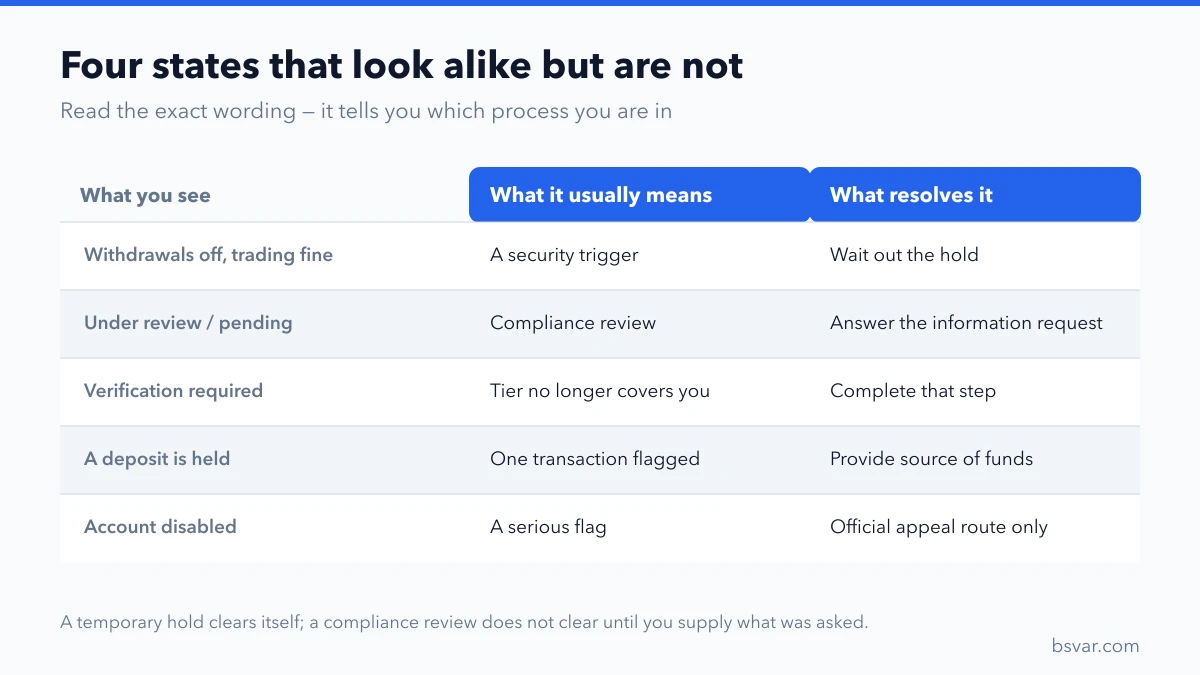
Short answer: "restricted", "locked", "disabled" and "under review" are not the same thing, and the right response differs for each. Before you do anything, read the exact wording of the message in your account — it tells you which process you are in, and therefore which route actually resolves it.
Do not open a second account. Do not accept help from anyone who contacts you. Both make the situation materially worse.
Work out which one you have
| What you see | What it usually means | What resolves it |
|---|---|---|
| Withdrawals disabled, trading fine | A security trigger — password change, new device, suspicious login | Usually a waiting period, then automatic restore |
| Account under review / pending | Compliance or risk review in progress | Respond to the information request; wait |
| Verification required to continue | Your KYC tier no longer covers what you are doing | Complete the requested verification step |
| Deposits blocked or a deposit held | A specific transaction was flagged | Provide source-of-funds evidence for that deposit |
| Account disabled or locked | A serious flag, or a request you made | Official appeal route only |
| Login blocked, credentials rejected | Possible compromise, or a self-triggered lock | Account recovery route |
The distinction that matters most: a temporary security lock usually clears on its own, while a compliance review does not clear until you supply what was asked for. Treating one like the other wastes weeks.
The most common causes
A security event you triggered yourself. Changing your password, adding a new withdrawal address, or logging in from a new device or country commonly imposes a temporary withdrawal hold — typically 24 to 48 hours. This is normal, and it is protecting you. Wait it out.
A risk-control flag on P2P activity. This is the big one for many users. Receiving payment from a bank account whose funds are later reported as fraudulent can freeze both your exchange account and, in some jurisdictions, your bank card. Doing everything inside the platform's order flow, with a payer name matching your verified identity, is what limits this exposure. See Is OKX P2P Safe? Scam and Account-Freeze Checklist.
Mismatched or incomplete verification data. A document expired, your registered country changed, or a higher tier is now required for what you are doing.
Unusual patterns. Sudden large volumes, rapid in-and-out transfers, or activity that resembles routing funds for someone else.
Suspected account sharing. Multiple accounts from one identity or device, or signs that someone else is operating the account.
Sanctions or jurisdiction changes. Service availability changes by region and is not negotiable through support.
What to do, in order
- Read the notice carefully. Screenshot it. The exact wording determines everything that follows.
- Check your email, including spam, for a request for information. Unanswered requests are the most common reason a review stalls indefinitely.
- Provide exactly what was asked. If they want a bank statement showing the source of a specific deposit, send that — not a folder of unrelated documents.
- Open one ticket through the official app or website. One. Duplicates reset your queue position.
- Be factual and complete in the first message: what you were doing, when, the amounts, and the relevant transaction IDs.
- Then wait. Days to several weeks is normal for manual review.
While you wait, do not move funds around, do not attempt workarounds, and do not change your registered identity details unless specifically asked.
What makes it worse
- Opening a second account. This is usually itself a terms violation and can turn a temporary restriction into a permanent one.
- Changing your nationality or residence in your profile to unlock a different option. These are statements of fact, not settings.
- Submitting someone else's documents. This ends accounts permanently and removes any legitimate route to your funds.
- Paying anyone who offers to unfreeze it. No such service exists. This is a scam that specifically targets people in your situation — see Fake Support Scams: Six Tells That Never Change.
- Posting your account details publicly while asking for help. It marks you as a target.
- Escalating aggressively. Reviews are queued, not negotiated.
Getting your funds out
If the outcome is that the account will be closed, most platforms provide a withdrawal path for the remaining balance once the review concludes — often to a verified address in your own name, and sometimes only back to the original funding source. Ask specifically about the withdrawal route in your ticket, since that is the question that actually matters to you.
Where funds are held pending an external investigation, the timeline is not set by the exchange, and no amount of escalation changes it.
Reducing the odds next time
- Keep verification current, and update details when they genuinely change.
- Use P2P strictly inside the platform's order flow, with a payer name matching your identity.
- Avoid rapid in-and-out patterns with no apparent purpose.
- Never accept funds on behalf of another person, however it is framed. This is how ordinary users become part of a money-laundering chain.
- Keep records: deposits, counterparties, and dates. Being able to document your source of funds quickly is what turns a three-week review into a three-day one.
- Do not concentrate everything on one platform.
FAQ
How long does a Binance review take?
There is no reliable universal figure. Automated holds often clear in 24 to 48 hours; manual compliance reviews commonly run days to weeks. Follow the status shown in your account.
Can support tell me why my account was flagged?
Often not in detail. Compliance processes generally limit what can be disclosed. This is frustrating but is not evidence that your case is being ignored.
Will my funds be returned if the account is closed?
In most legitimate cases, yes, subject to the review outcome and any legal constraints. Ask specifically about the withdrawal route.
Should I use a service that unfreezes accounts?
No. There is no legitimate version of this service, and engaging with one typically costs you more money on top of the original problem.
Can I appeal a permanent decision?
Platforms usually have one appeal route. Use it once, thoroughly, with documentation. Repeated appeals with no new information rarely change anything.
Does this mean I did something illegal?
Not necessarily. Risk systems flag patterns, and false positives are routine. Being flagged is not an accusation.
Related guides
- Binance KYC Verification: Documents, Selfie and Failure Fixes
- Is OKX P2P Safe? Scam and Account-Freeze Checklist
- Fake Support Scams: Six Tells That Never Change
- How to Withdraw Crypto From Binance to a Wallet
Educational content, not legal or financial advice. Account decisions are made by the platform under applicable rules and can change. Follow the official instructions shown in your own account. See our Advertising & Commission Disclosure.