
Coin Basics
What Is the Bitcoin Halving? Its Effect on Price (2026)
What the Bitcoin halving is, the ~4-year mechanism, and its effect on supply and price.

Last updated: June 2026 · By the bsvar editorial team
Every few years the crypto world buzzes about the "Bitcoin halving." What is it, and why does it matter? Here it is in plain English.
⚠️ Risk warning: Educational content, not investment advice. The halving has no guaranteed link to price — don't invest based on it. See our Disclaimer.
At a glance
What the halving is
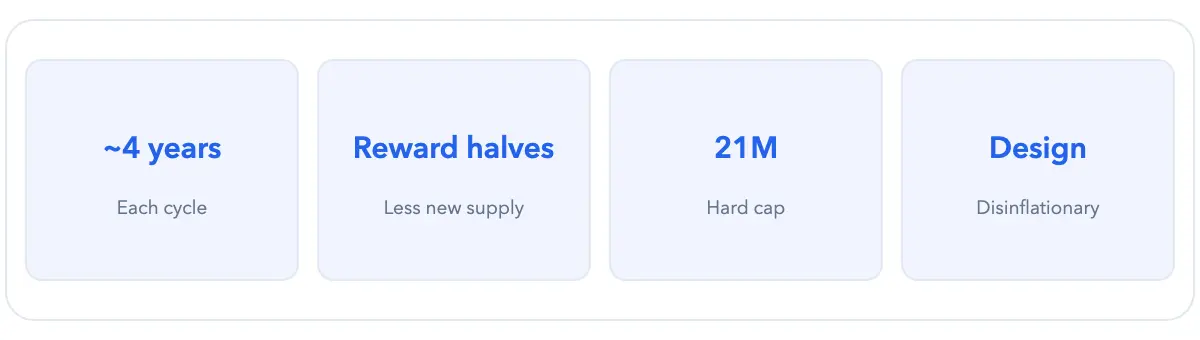
New bitcoins are created through "mining," and miners earn a block reward for each block. Bitcoin's protocol says that roughly every four years (every 210,000 blocks), this reward is cut in half. In other words, new supply is issued at a periodically halving rate.
Why it's designed this way
It's part of Bitcoin's fixed 21-million supply and disinflationary model — each halving means fewer new coins, until they're all issued. New to Bitcoin? See What Is Bitcoin.
Effect on price
- In theory, less new supply with steady demand could support price long-term;
- But past performance doesn't predict the future — price depends on many factors, and halving ≠ guaranteed rally;
- Don't treat a "halving rally" as a sure-thing investment thesis.
FAQ
How often does it happen? Roughly every four years (counted in blocks, not exact dates). Does price always rise after a halving? No guaranteed relationship — don't be misled by "halving = moon" claims. Does it affect how I buy? Just know it as a long-term supply event; normal buying is unaffected — see How to Buy Bitcoin.
Next steps
A halving is not a scheduled price increase
A halving directly changes new issuance, not the market price. Demand, liquidity, interest rates, miner economics, and expectations still matter, and the event is usually discussed long before it occurs. Past price paths therefore cannot simply be copied onto the next cycle.
For a useful study, record the halving block and date, the price range six to twelve months before and after, the macro environment, network hash rate, and fee conditions. This prevents cherry-picking only the rising period. For beginners, the halving is best treated as a lesson in Bitcoin’s issuance rules—not a trading calendar.
Content is for reference only. See our Advertising & Commission Disclosure.