
Coin Basics
What Is Bitcoin (BTC)? The Network, Coin and Blockchain
Bitcoin is a public network and BTC is its native asset. Learn how wallets, transactions, blocks and confirmations fit together, plus what a public ledger can and cannot prove.
Bitcoin (BTC) is digital money recorded on a public network rather than in an account run by one bank. “Bitcoin” can mean the network and its rules; “BTC” is the asset transferred under those rules. If you are wondering about blockchain vs crypto, Bitcoin is a useful example: its blockchain is the shared transaction record, while BTC is the asset the record tracks. Our explanation of blockchain and cryptocurrency explores that distinction across other networks too.
What happens when someone sends BTC?
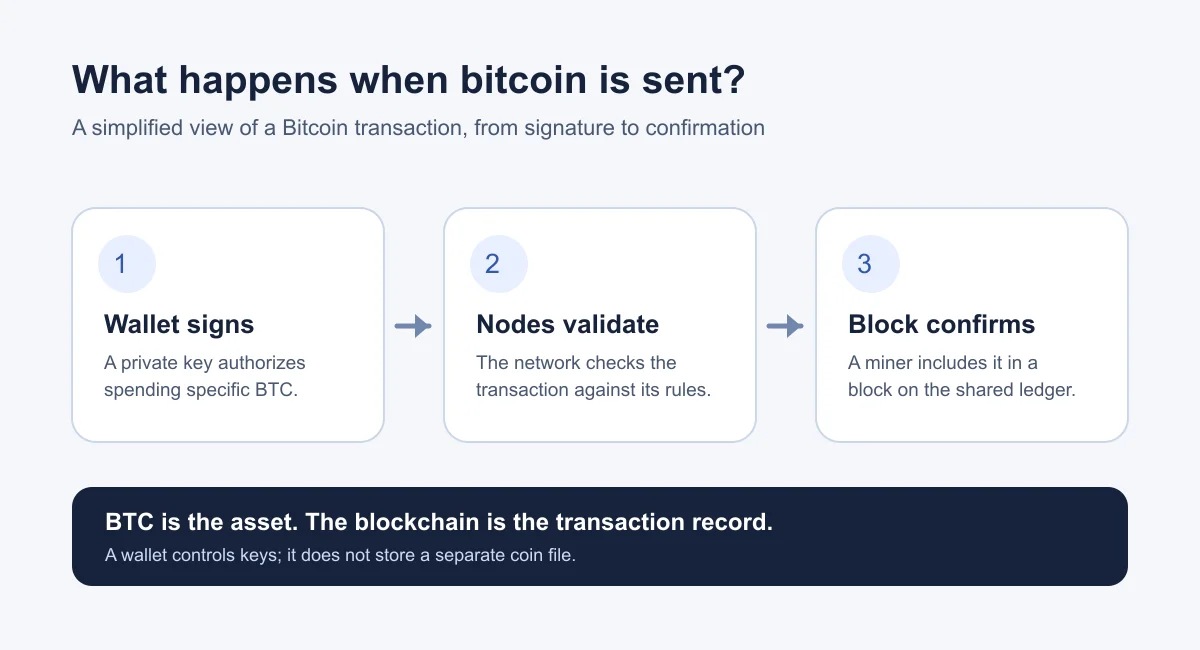
A Bitcoin wallet prepares a transaction that identifies the funds being spent and the new destination. The wallet uses a private key to sign it. The signed transaction is broadcast, and network nodes check whether it follows Bitcoin's rules, including whether the funds have already been spent. Miners can then include a valid transaction in a block. Once that block is accepted, the transaction has one confirmation; later blocks add further confirmations. This is a simplified description of the process in Bitcoin.org's how-it-works guide.
A simplified transaction flow, based on Bitcoin.org's explanation of transactions and mining. It is a diagram, not a wallet or exchange screen.
The wallet does not contain a separate coin file. It manages the keys needed to spend eligible transaction outputs recorded by the network. Bitcoin's developer guide to transactions calls these unspent transaction outputs, or UTXOs. That is why losing access to a self-custodied wallet's keys is different from forgetting a bank password: the network has no central desk that can reset a private key.
What makes Bitcoin different from a bank balance?
A bank records your balance in its own system and can update it under its account rules. Bitcoin participants can independently check the public chain and the rules for accepting transactions. The record is public, but a Bitcoin address is not automatically a person's real name. Transactions may still be linked to people through how they use addresses or services, so “public” does not mean “anonymous.” Bitcoin.org makes this distinction in its user safety guide.
There is also a difference between holding BTC in your own wallet and seeing a BTC balance at an exchange. With self-custody, you control the relevant keys and must protect your recovery information. At an exchange, the operator handles custody and withdrawals under its own terms. Our cold-wallet versus hot-wallet guide helps explain which responsibilities come with each arrangement.
Is Bitcoin's supply fixed, and do you need a whole coin?
Bitcoin's issuance rules limit total creation to about 21 million BTC. A bitcoin can be divided into 100 million satoshis, so ownership does not require buying a whole coin. These are rules of the asset, not a promise that its price will rise. The Bitcoin.org FAQ on supply and divisibility explains both numbers.
The market price can change sharply even while the network continues to work as designed. Fees and confirmation times also vary: paying a fee does not buy a guaranteed arrival time, because block discovery and demand are variable. Before any real transfer, check the receiving address and the exact network; a visible transaction cannot by itself prove that a person or service is trustworthy.
How can you verify a Bitcoin transfer?
A transaction ID lets you look up a broadcast or confirmed transaction on a Bitcoin block explorer. Check the network, recipient address, amount and confirmation status against what you intended. An explorer reports what it sees on-chain; it cannot establish the identity or honesty of the recipient. If you need to interpret those fields, follow our guide to checking a transaction with a block explorer.
In short, Bitcoin is both a set of network rules and the name commonly used for its native asset. BTC is the asset, a wallet manages the keys used to spend it, and the blockchain records confirmed transactions. Understanding those separate roles makes it easier to evaluate claims about payments, custody and “crypto” products.