
Coin Basics
Stablecoin Depegs: What They Are and the Real Risk to You (2026)
A depeg is a stablecoin trading away from its reference value. Brief deviations are noise; the real risk is panic-selling into thin liquidity.
Published: September 2026 · By the bsvar editorial team
Short answer: a depeg is when a stablecoin trades away from the value it is supposed to track — a coin meant to be worth one dollar changing hands at 98 cents. Small, brief deviations are normal market noise and usually correct themselves. A large or sustained one signals a real problem with the backing or the redemption mechanism.
The practical risk for most users is not the depeg itself. It is panic-selling into a thin market during one, which converts a temporary paper deviation into a permanent realised loss.
What "pegged" actually means
A stablecoin promises to hold a stable value against a reference, usually the US dollar. But nothing forces the market price to obey that promise. The price on any exchange is simply whatever buyers and sellers agree to right then.
What keeps it near the peg is arbitrage. If a coin backed by real reserves trades at 99 cents, someone can buy it cheaply and redeem it with the issuer for a full dollar, pocketing the difference. That buying pressure pushes the price back up. The peg holds because breaking it is profitable to fix.
That mechanism has a critical dependency: redemption has to actually work. If redemption is paused, restricted to large institutional holders, or subject to doubt about the reserves, the corrective force weakens and the gap can widen and persist.
The types, and how they fail
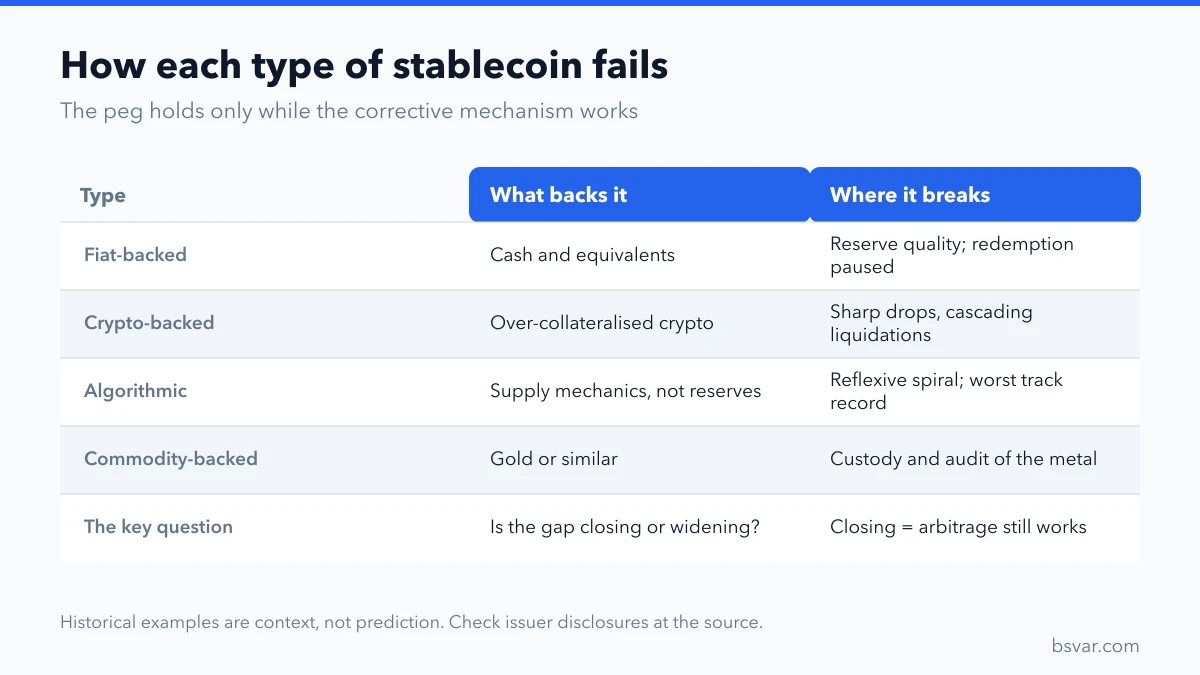
Fiat-backed (the most widely used, including USDT and USDC). Each token is meant to be backed by cash and cash-equivalent reserves held by the issuer. The risks are the quality and liquidity of those reserves, where they are held, and whether redemption remains available. A notable historical example: in March 2023, USDC briefly traded well below a dollar after it emerged that part of its reserves sat at a bank that had failed. It recovered once the deposits were confirmed as accessible — the mechanism worked, but only after a frightening weekend.
Crypto-backed. Backed by other crypto assets, over-collateralised to absorb volatility. Risk concentrates in a sharp market drop that triggers cascading liquidations.
Algorithmic. Maintains the peg through supply mechanics rather than reserves. This category has the worst historical record. The 2022 collapse of TerraUSD destroyed tens of billions in value within days, in a reflexive spiral where falling price triggered mechanics that drove the price lower still. Treat any algorithmic stablecoin as a high-risk asset regardless of how it is marketed.
Commodity-backed. Tracks gold or similar. Depends on custody and audit of the physical asset.
Reading a deviation correctly
Not every price wobble is a crisis.
Usually noise: a deviation of a fraction of a percent, lasting minutes, on one exchange only, with no news. This is ordinary order-book imbalance and thin weekend liquidity.
Worth attention: a deviation of a percent or more, persisting for hours, visible across multiple venues, or accompanied by news about the issuer, reserves, or a banking partner.
Serious: a large deviation that widens rather than narrows, redemptions paused or restricted, the issuer going quiet, or reserve disclosures being questioned.
The distinguishing question is always the same: is the gap closing or widening? A recovering peg indicates arbitrage is functioning. A widening one indicates it is not.
What it means for you
If you hold stablecoins simply as a place to sit between trades, a brief depeg usually means nothing — provided you do not act on it. The coin either recovers, and you were never affected, or it does not, and selling early would have mattered. Distinguishing the two in real time, under pressure, with incomplete information, is much harder than it sounds afterwards.
The consistent pattern in past events is that people who sold into the panic locked in losses, while those who waited were generally made whole. That is a description of what happened before, not a promise about what will happen next.
Sensible precautions
- Don't hold more in stablecoins than the purpose requires. They are a transit and settlement tool, not a savings vehicle.
- Diversify across issuers if you hold a meaningful balance. Different issuers have different reserve structures and failure modes.
- Prefer transparent issuers who publish regular reserve attestations. Check them at the source rather than through a summary.
- Understand what backs it before you hold it. If you cannot explain the mechanism in a sentence, that is a reason for caution.
- Be sceptical of high yields on a stablecoin. Above-market returns come from somewhere, and that somewhere is risk you are being paid to absorb.
- Do not trade a depeg unless you genuinely understand the redemption mechanics. This is where inexperienced traders lose the most.
- Keep some assets off-exchange if you hold long term.
FAQ
Is USDT going to depeg?
Nobody can answer that. USDT has held its peg through multiple stress events, and its issuer publishes reserve reports. It also carries real reserve-composition and redemption risk, as every fiat-backed stablecoin does. Check the current disclosures rather than any prediction.
What happens to my coins during a depeg?
Nothing changes on the blockchain — you hold the same tokens. Only the market price moves. Whether that becomes a loss depends entirely on whether you sell.
Should I sell during a depeg?
That depends on facts you may not have in the moment. Panic-selling into thin liquidity is the most reliable way to turn a temporary deviation into a permanent loss.
Are stablecoins insured?
Generally not in the way bank deposits are. Reserve backing is not the same as deposit insurance, and protections vary by issuer and jurisdiction.
Which stablecoin is safest?
There is no risk-free option. Fiat-backed coins from transparent, well-audited issuers generally carry lower mechanism risk than algorithmic ones — but "lower" is not "none".
Can a depegged coin recover?
Yes, it has happened repeatedly, where reserves were genuinely intact. Coins that failed structurally, such as algorithmic ones without real backing, generally did not.
Related guides
- What Is USDT? Stablecoins Explained for Beginners
- TRC20 vs ERC20 USDT: Which One Should You Choose?
- DEX vs CEX: What's the Difference and Which Should You Use?
- Avoid Crypto Scams: Common Scams and How to Spot Them
Educational content, not financial advice. Historical examples are described for context and do not predict future outcomes. Verify issuer disclosures at the source before relying on any stablecoin. See our Advertising & Commission Disclosure.