
Web3 & DeFi
Crypto Bridges: How They Work and Where the Risk Really Is (2026)
A bridge moves value between chains that cannot talk to each other. Why bridges get exploited, and why an exchange is usually the safer route.
Published: October 2026 · By the bsvar editorial team
Short answer: a bridge moves value between two blockchains that cannot talk to each other directly. It does this by locking your asset on the source chain and issuing a representation on the destination chain. Bridges have historically been among the most heavily exploited components in crypto — and for most users, a centralised exchange achieves the same result with less risk.
If your goal is simply "my USDT is on Tron and I need it on Ethereum", you probably do not need a bridge. Deposit to an exchange on one network and withdraw on the other.
Why bridges exist
Blockchains are independent systems. Ethereum has no way to observe or verify what happened on Solana. There is no native mechanism for sending an asset from one to the other, and no shared ledger.
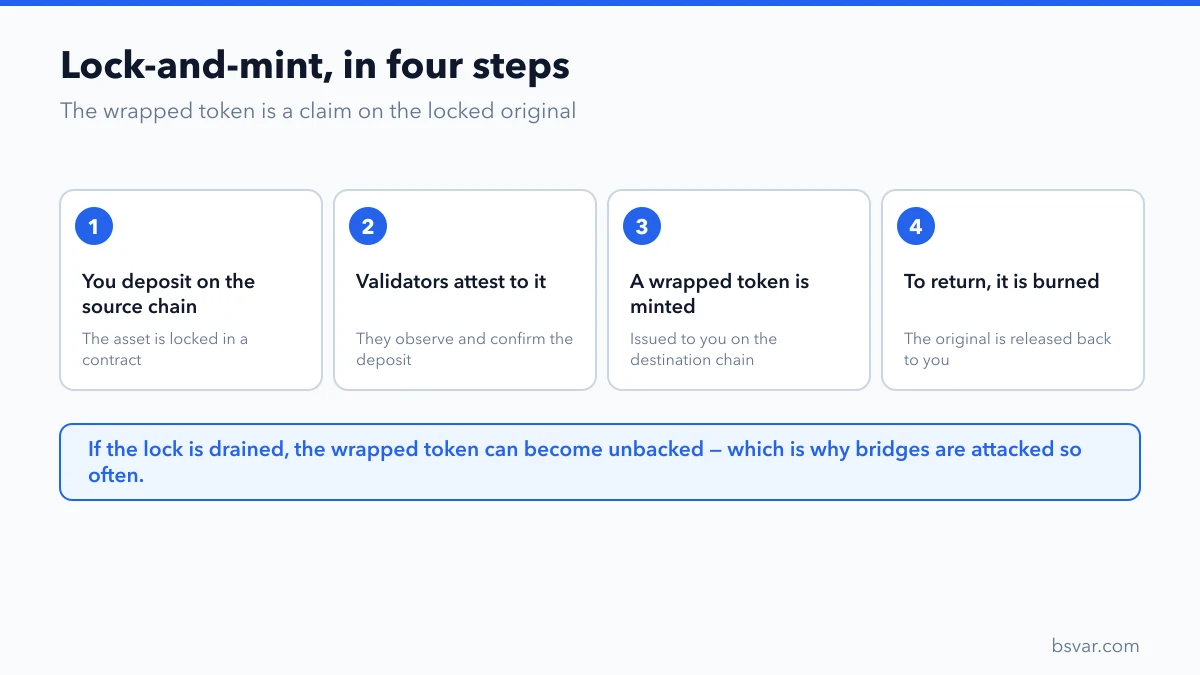
A bridge fills that gap. The most common pattern is lock-and-mint:
- You deposit an asset into a contract on the source chain, which locks it.
- The bridge's validators observe and attest to that deposit.
- A wrapped representation is minted for you on the destination chain.
- To go back, you burn the wrapped token and the original is released.
The wrapped token is a claim on the locked original. Its value depends entirely on the locked asset still being there and still being redeemable. That is the crux of bridge risk.
Other designs exist — liquidity-pool bridges that use pre-funded pools on both sides, and validator or relayer networks that attest to cross-chain messages. The security assumptions differ, but the question is always the same: who or what guarantees the destination token is redeemable, and what happens if they fail?
Why bridges are attacked so often
Bridges concentrate large amounts of locked value in a small number of contracts and validator sets. That is an attractive target, and the attack surface is unusually wide: the contracts on both chains, the validator set, the message-passing layer, and the key management of whoever operates it.
Several of the largest exploits in crypto history have been bridge exploits, typically through forged deposit proofs or compromised validator keys. When a bridge is drained, the wrapped tokens on the destination chain may become unbacked — holders can be left with a token that no longer represents anything, even though they did nothing wrong.
This is a structural property, not a criticism of any particular project.
The exchange alternative
For a simple chain change of a widely supported asset, the exchange route is usually better:
- Withdraw the asset from your wallet to an exchange, on the network it is currently on.
- Wait for it to be credited.
- Withdraw it again, selecting the destination network.
You pay two withdrawal fees, and you take on custody risk while the funds sit there. In exchange, you avoid smart-contract and validator risk entirely, and there is a support channel if something goes wrong. For most people, that is the better trade. See How Exchange Withdrawal Fees Actually Work.
When a bridge is genuinely the better option: the asset is not listed on any exchange you can use; the destination chain is not supported for withdrawals; you are already operating in DeFi on both chains; or you specifically need to avoid a custodial step.
Using one with the risk managed
If you have decided a bridge is necessary:
- Reach it by typing the address or from a bookmark. Fake bridge front-ends are among the most profitable phishing targets, and they buy search ads. Never arrive from a chat link or a social post.
- Verify the contract address from an independent source such as the project's documentation or the block explorer's verified listing.
- Check what you receive. Some bridges deliver a canonical asset, others a project-specific wrapped token with different liquidity and acceptance. Confirm the destination token is the one you actually want.
- Confirm the destination chain is right, and that your wallet supports it.
- Send a small test first. Always, on any bridge you have not used before.
- Hold native gas on the destination chain — otherwise the arriving funds are stranded, since you cannot pay for a transaction to move them.
- Check the approval you are granting. Bridging requires a token approval; prefer an exact amount over unlimited where offered, and revoke afterwards. See How to Revoke Token Approvals Safely.
- Keep the transaction hashes for both sides.
- Do not bridge more than you can afford to lose, particularly on a newer bridge.
When a bridge transfer does not arrive
Bridging is a multi-step process, and delays are common rather than alarming.
- Check the source-chain transaction on an explorer to confirm it confirmed. See How to Use a Block Explorer to Check Any Transaction.
- Check the bridge's own status or transaction-tracking page — many have one.
- Confirm your wallet is switched to the destination chain and that the token is added. It often "arrives" invisibly because the wallet is not displaying it.
- Allow time. Cross-chain finality can take minutes to hours depending on design and congestion.
- Use the project's official support channel only. Anyone who contacts you first about a stuck bridge transfer is running a scam — this is one of the most reliably targeted situations in crypto.
FAQ
Is bridging safe?
It carries risks that an ordinary transfer does not: contract risk, validator risk, and front-end phishing risk. Established bridges with long track records are lower risk than new ones, but none are risk-free.
Is a wrapped token the same as the real one?
No. It is a claim on a locked original. Its value depends on the backing remaining intact and redeemable.
Can I bridge anything to anywhere?
No. Each bridge supports specific chains and assets. Check support before sending.
Why did my bridged tokens not show up?
Most often the wallet is on the wrong network or has not added the token contract. Check both before assuming a loss.
Are bridges cheaper than exchanges?
Sometimes on fees, but the comparison should include risk. Two withdrawal fees on an exchange can be cheaper than an exploited bridge.
What if the bridge gets hacked while my funds are in transit?
This is the scenario that makes bridges different from ordinary transfers. Recovery depends entirely on the project, and there is often none. This is why test amounts and position sizing matter.
Related guides
- TRC20 vs ERC20 USDT: Which One Should You Choose?
- How Exchange Withdrawal Fees Actually Work
- How to Revoke Token Approvals Safely
- What Is Web3? Wallets, DeFi and DEX Explained
Educational content, not financial advice, and not an endorsement of any specific bridge. Verify current contract addresses and official front-ends at the source before use. See our Advertising & Commission Disclosure.