
Coin Basics
Blockchain vs Cryptocurrency: What Is the Difference?
Blockchain is a way to maintain a shared record; cryptocurrency is a digital asset a network may use. See how Bitcoin, Ethereum and permissioned ledgers fit together.
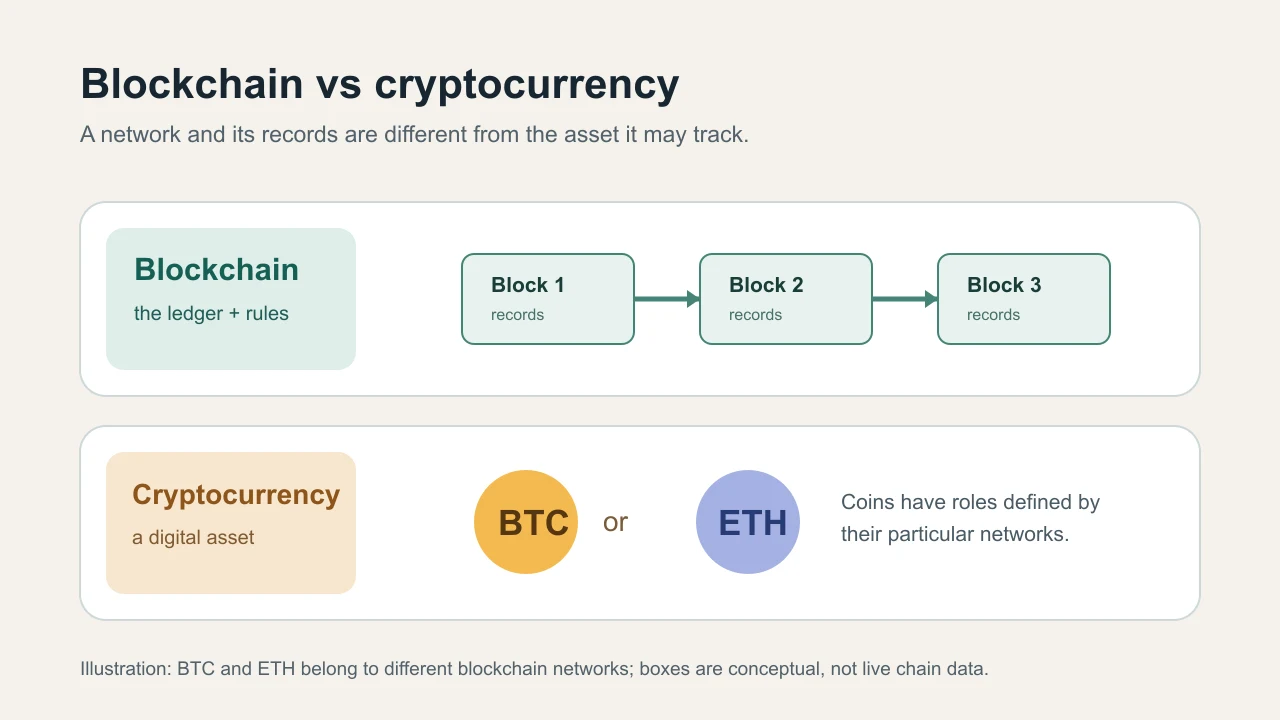
Blockchain and cryptocurrency are related, but they answer different questions. A blockchain is a way for a network to agree on and maintain a shared record. A cryptocurrency is a digital asset whose ownership and transfers are recorded under a network's rules. Bitcoin uses a blockchain to track bitcoin (BTC); Ethereum uses one to run applications and track ether (ETH), among other assets. The record is not the coin.
What does a blockchain do?
A blockchain groups records into blocks. Each new block refers cryptographically to an earlier one, giving participants a common history that is difficult to change without detection. The computers participating in a network follow rules for accepting new records and agreeing on the order of blocks. This is more specific than an ordinary database: the design is meant to let multiple participants share a history under a defined set of trust and validation rules.
That does not mean every blockchain is public or that every participant has equal control. The US National Institute of Standards and Technology (NIST) distinguishes permissionless networks, where participation in publishing blocks is open, from permissioned networks, where only authorized participants may do so. Read access can also differ. Before trusting a claim that something is ‘on a blockchain,’ ask who can add records, who can inspect them, and which rules settle disagreements.
What is a cryptocurrency?
A cryptocurrency is an asset used within a cryptographic network. It can serve different purposes depending on that network's design. On Bitcoin, BTC is the asset transferred under Bitcoin's rules. For the network and asset together, see our plain-English introduction to Bitcoin. On Ethereum, ETH pays transaction fees and plays a role in securing the network; the chain also supports applications and other digital assets. Our Ethereum beginner guide explains that wider role.
A cryptocurrency's price is not a measure of how well its underlying record system works. A network may process transactions as designed while an asset's market price rises or falls. Likewise, a token bearing a familiar name does not prove that it was issued by the party you expect. You must identify the actual network and asset before sending funds.
| Question | Blockchain | Cryptocurrency |
|---|---|---|
| What is it? | A shared record and the rules for updating it | A digital asset tracked under network rules |
| What do you inspect? | Participants, validation rules and recorded transactions | Asset identity, use, supply rules and transfer conditions |
| Example | The Bitcoin network's chain of blocks | BTC, the asset transferred on Bitcoin |
Does every blockchain need a coin?
No. Public, permissionless networks commonly use a native asset to pay fees or reward participants. But NIST describes permissioned blockchains whose authorized participants can use different arrangements for maintaining the record. A publicly traded cryptocurrency is therefore not a defining requirement for every blockchain. Whether a particular private system is useful or trustworthy still depends on its governance and the problem it solves; the word ‘blockchain’ alone proves neither.
Conversely, do not treat every form of digital money as cryptocurrency. A balance in a bank app is digital, but it is recorded and controlled under the bank's system rather than being BTC or ETH on their respective networks. The useful distinction is who maintains the record and what rules define the asset.
How can you tell which one someone means?
When an article, app or project says ‘crypto’ or ‘blockchain,’ check three things:
- Name the network. Is it Bitcoin, Ethereum or another system? Find the network's own documentation rather than relying only on marketing language.
- Name the asset. Is it a native coin, a token issued on that network, or simply an account balance in a company database? These are different claims.
- Check what can be verified. If a transfer is said to be on a public chain, a transaction identifier should let you inspect its recorded status. Our guide to checking a transaction with a block explorer explains what that record can and cannot tell you. A transaction visible on-chain does not, by itself, verify the legitimacy of the person or service involved.
The short answer: a blockchain is the record-keeping system; a cryptocurrency is one kind of asset a system may track or use. Understanding both parts helps you read product claims and transfer instructions more carefully.
Primary references
- NIST, Blockchain Technology Overview — permissionless and permissioned network definitions.
- Ethereum.org, Technical introduction to Ethereum — linked blocks, network rules and ETH's role.
- Bitcoin white paper — the original design for Bitcoin's peer-to-peer electronic cash system.