
Web3 & DeFi
DEX vs CEX: What's the Difference and Which Should You Use? (2026)
A CEX holds your funds and gives you an account; a DEX connects to your wallet and holds nothing. The real difference is who is responsible when things go wrong.
Published: September 2026 · By the bsvar editorial team
Short answer: a centralised exchange (CEX) holds your funds and gives you an account; a decentralised exchange (DEX) never holds anything and connects directly to your wallet. For a beginner, a CEX is almost always the right starting point — it is the only one that converts normal money into crypto, and it forgives mistakes that a DEX does not.
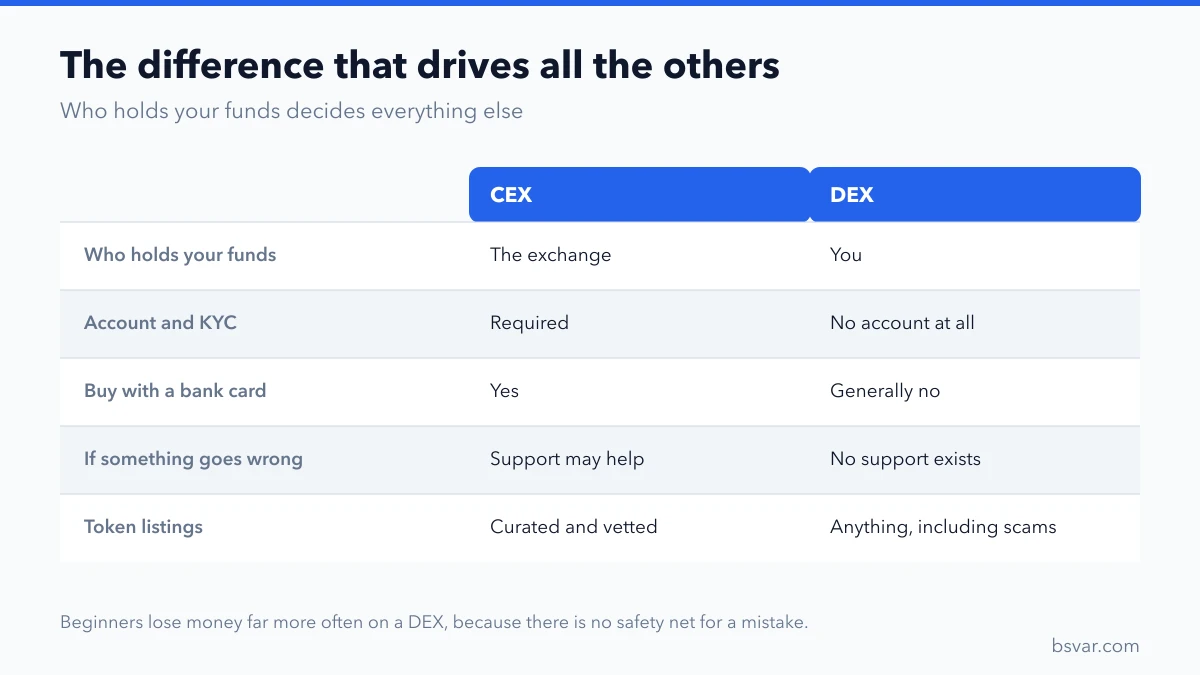
The real difference is not technology. It is who is responsible when something goes wrong — a company, or you.
The core distinction: custody
On a CEX, you deposit funds and the platform holds them. Your balance is a database entry, and the exchange controls the private keys. Trading happens on the company's internal system, not on a blockchain.
On a DEX, you connect a wallet you control. Trades execute through smart contracts on a blockchain. The DEX never takes possession of your assets — it matches and settles, then the funds go straight back to your wallet.
Everything else follows from that one difference.
Side by side
| CEX | DEX | |
|---|---|---|
| Who holds your funds | The exchange | You |
| Account required | Yes, with KYC | No account |
| Buy with a bank card or transfer | Yes | Generally no |
| If you lose your password | Recoverable via support | Not applicable |
| If you lose your seed phrase | Not applicable | Funds are gone permanently |
| Mistaken transaction | Support may help | No support exists |
| Available tokens | Curated, vetted listings | Anything anyone lists, including scams |
| Fees | Trading fee, withdrawal fee | Swap fee plus network gas |
| Platform risk | Freeze, insolvency, restriction | Smart-contract bugs and exploits |
| Speed for beginners | Fast to start | Requires a funded wallet first |
When a CEX is the right choice
- You are converting government-issued money into crypto. This is the decisive one. A DEX cannot take your bank transfer or card payment. Almost every crypto journey starts at a CEX for this reason alone.
- You are new. The interface is familiar, mistakes are often recoverable, and there is someone to ask.
- You want to trade major assets with deep liquidity and tight spreads.
- You want to cash out back to a bank account.
- You do not want to manage keys yet. That is a reasonable position, not a failure.
The trade-off is real: you are trusting a company. Accounts can be restricted, platforms can fail, and you cannot control either. See Binance Account Restricted or Locked? Tell the Two Apart First.
When a DEX makes sense
- You already hold crypto in a wallet and want to swap it for another token.
- The token is not listed on any exchange you use. This is the most common genuine reason.
- You want to interact with DeFi — lending, liquidity provision, staking.
- You prefer holding your own keys and accept full responsibility for that.
The trade-off here is equally real: no account means no recovery. There is no password reset, no support ticket, and no mechanism to reverse anything.
The risks that are specific to each
On a CEX: account restrictions, withdrawal holds, regional availability changes, and — in the worst case — platform insolvency. The standard mitigation is not keeping more on a platform than you need there.
On a DEX: these are the ones beginners underestimate.
- Fake tokens. Anyone can create a token with any name. A DEX does not vet listings. Always verify the contract address from an independent source, never from a link in a chat or a social post.
- Token approvals. Swapping requires granting a contract permission to move your tokens. A malicious contract can use that permission later. Review and revoke approvals periodically — see How to Revoke Token Approvals Safely.
- Slippage and low liquidity. A thin market can execute your trade at a far worse price than displayed. Set a slippage limit.
- Gas costs. Every action costs the network's native asset, including failed transactions.
- Phishing front-ends. A DEX is a website. Fake copies rank in search ads. Bookmark the real one.
- Smart-contract risk. Even audited contracts have been exploited.
A sensible path for a beginner
- Start on a reputable CEX. Complete verification, enable authenticator-app 2FA, and turn on the withdrawal whitelist.
- Buy a major asset and get comfortable with deposits and withdrawals.
- Set up a self-custody wallet and back up the seed phrase offline. Practise sending a small amount to it and back.
- Only then, if you have a specific reason, try a DEX with an amount you can afford to lose entirely.
- Never move your whole balance into an unfamiliar system in one step.
Most people never need step four. That is a perfectly good outcome.
FAQ
Which is safer?
Neither, categorically — the risks are different in kind. A CEX exposes you to the company; a DEX exposes you to your own mistakes and to contract risk. Beginners lose money far more often on DEXs, because there is no safety net.
Can I buy crypto with a bank card on a DEX?
Generally no. DEXs trade crypto for crypto. Fiat entry normally requires a CEX or a regulated payment provider.
Do I need KYC for a DEX?
Typically not, since there is no account. But no KYC also means no recovery, no support and no dispute process.
What if I send funds to a DEX by mistake?
There is nothing to send funds to — a DEX has no deposit address. If you sent to a contract address, it is generally not recoverable.
Are DEX fees lower?
Sometimes the swap fee is lower, but you also pay network gas on every action. On an expensive network, small swaps can cost more overall than on a CEX.
Can a DEX freeze my funds?
The DEX itself cannot, since it never holds them. But a malicious token contract can restrict what you can do with that specific token.
Related guides
- What Is Web3? Wallets, DeFi and DEX Explained
- How to Revoke Token Approvals Safely
- Cold vs Hot Wallet: What's the Difference and How to Choose
- Withdrawal Address Whitelist: The Setting That Stops the Costliest Mistake
Educational content, not financial advice. Platform features and regional availability change; verify current details before use. See our Advertising & Commission Disclosure.