
Guides
TRC20 vs ERC20 USDT: Which One Should You Choose? (2026)
TRC20 or ERC20 for USDT? The receiving side decides. Compare fees, speed and compatibility, then match the network your recipient actually supports.
Last updated: August 2026 · By the bsvar editorial team
Short answer: choose the network the receiving side supports. If the recipient only accepts USDT on Tron, choose TRC20. If it only accepts USDT on Ethereum, choose ERC20. If both work, TRC20 is usually the cheaper option for simply moving USDT between accounts, while ERC20 is the one you need for Ethereum DeFi. The network is a property of the destination, not a preference you get to express.
Never pick a network from the address alone. Confirm the asset label and the network label on both screens before sending. On-chain transfers are normally irreversible, and a deposit sent over an unsupported network may never be credited.
Quick decision table
| Where the USDT is going | Network to choose |
|---|---|
| An exchange deposit page | Exactly the network that deposit page lists as supported |
| An Ethereum wallet or Ethereum DeFi app | ERC20 |
| A Tron wallet or Tron-based service | TRC20 |
| Another exchange account of your own, both networks supported | TRC20 is normally cheaper; confirm the live fee first |
| An Ethereum smart contract, staking or lending pool | ERC20 — Tron USDT cannot interact with Ethereum contracts |
| You are not sure | Stop. Ask the recipient or platform support before sending |
What TRC20 and ERC20 actually mean
USDT is a single dollar-denominated token issued by Tether, but it exists on many blockchains at once. TRC20 USDT lives on the Tron network. ERC20 USDT lives on Ethereum. "TRC20" and "ERC20" are the token standards each chain uses — they describe how a token behaves on that chain, not a different kind of dollar.
The practical consequence is the part beginners miss: these are separate blockchain assets. Your TRC20 balance and your ERC20 balance are recorded on two different ledgers that have no direct knowledge of each other. A TRC20 transfer cannot land in an ERC20 wallet, because the two networks do not talk to each other without an intermediary such as an exchange or a bridge.
Tether publishes the supply it has issued on each chain, which is the clearest way to see that these really are parallel ledgers of the same token:
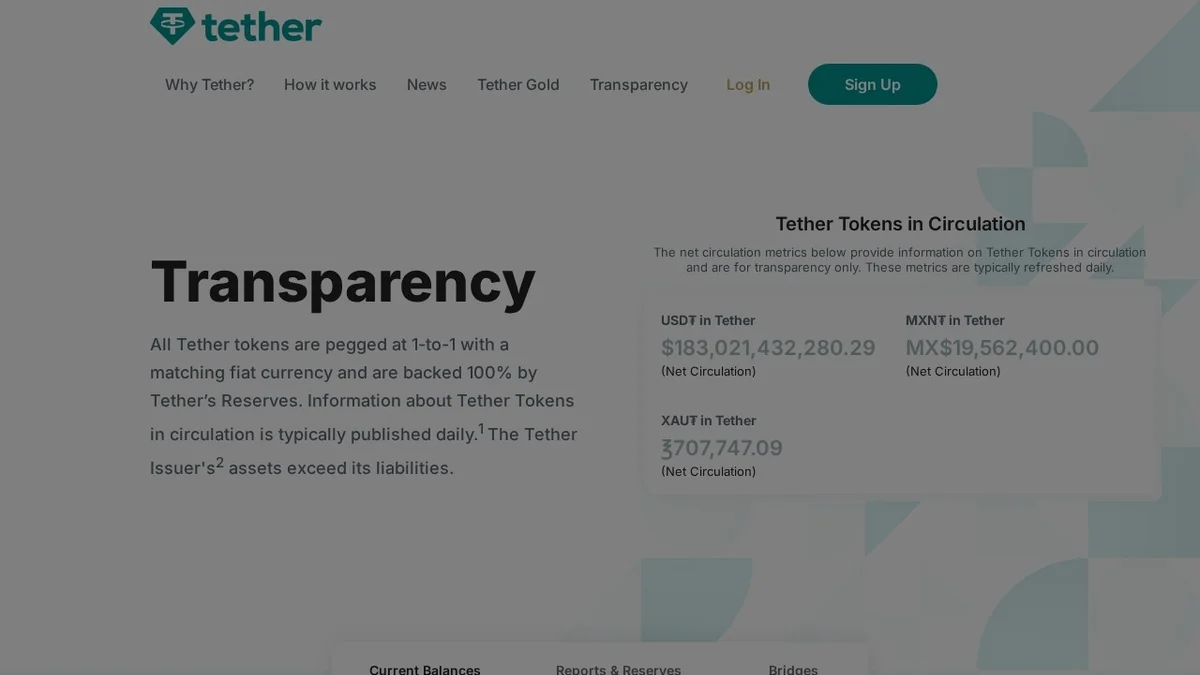
Tether's official transparency page. Figures update continuously — read the live page rather than any number quoted in a guide.
Tron is a separate layer-1 blockchain that has become one of the most heavily used rails for USDT transfers, largely because of its low transaction costs:
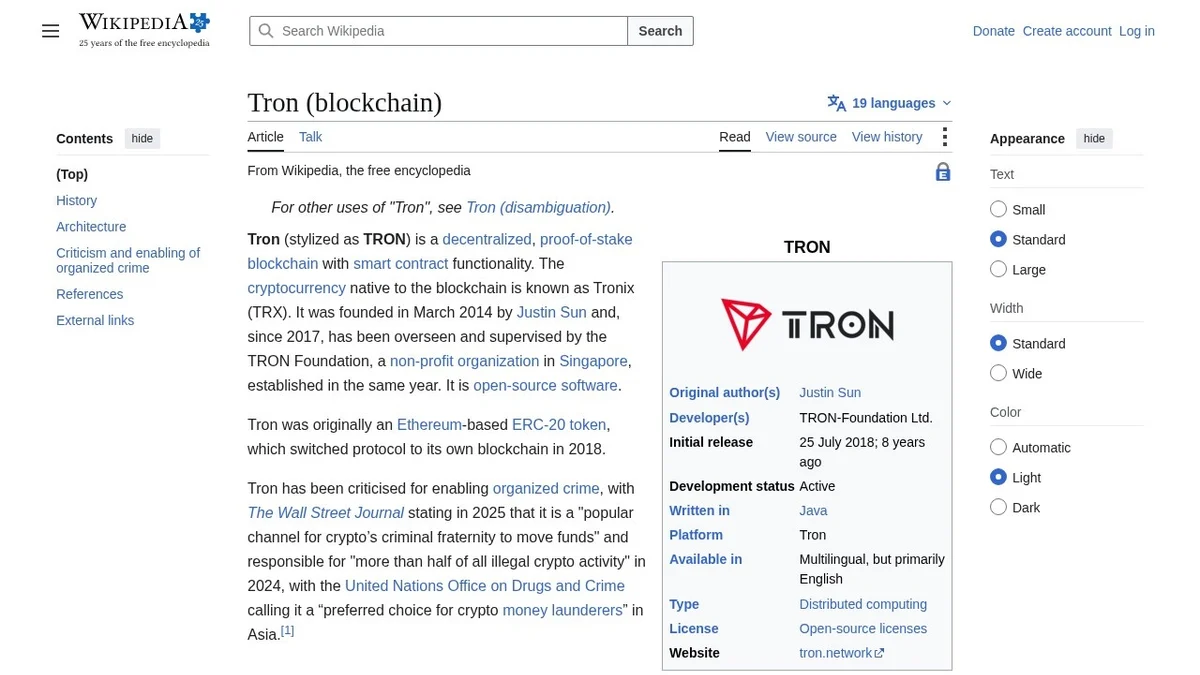
Background reference: Tron (blockchain) on Wikipedia.
TRC20 vs ERC20 side by side
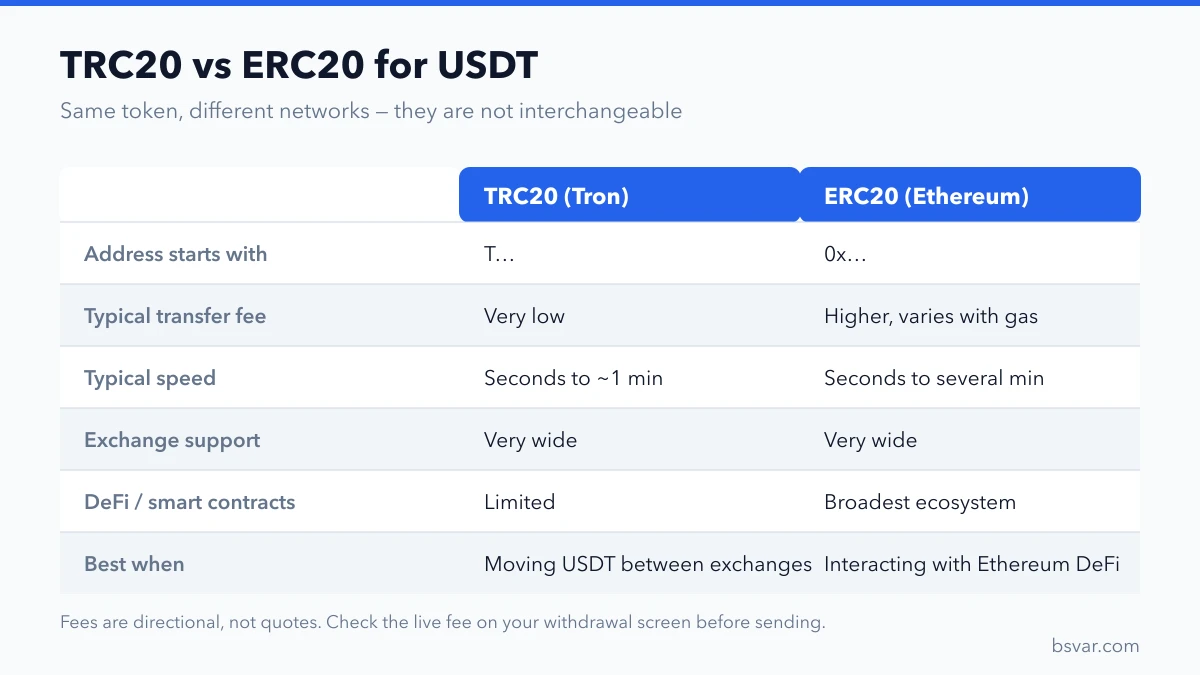
The technical standards themselves are documented by Tron and Ethereum.
Two rows in that table deserve expanding, because they are where the actual money is.
Fees: what you are really paying
The number you see on a withdrawal screen usually bundles two different things:
- The exchange's withdrawal fee. A flat amount the platform charges, set by the platform. It often differs per network and can change without much notice.
- The underlying network cost. On Ethereum this is gas, which is priced by live demand for blockspace. A quiet Sunday and a busy NFT mint can differ by an order of magnitude. On Tron the cost model is different and generally far lower and more stable.
This is why "ERC20 costs $X" is never a fact you should copy from a tutorial — including this one. The only figure that matters is the one quoted on your confirmation screen at the moment you send. What is durable is the direction: for a plain USDT transfer, ERC20 is normally the more expensive of the two, sometimes dramatically so, and TRC20 is normally cheap enough that the fee is not a factor in the decision.
Speed and confirmations
Both networks typically settle a USDT transfer in seconds to a few minutes. The delay you actually experience is usually not the blockchain — it is the receiving platform's confirmation policy. An exchange may require a set number of block confirmations before crediting your balance, and that number differs per network and per platform. A transfer can be final on-chain and still show as pending in your account for several more minutes. That is normal and is not a sign that anything went wrong.
How to choose in four real situations
Moving USDT between two of your own exchange accounts. Both platforms almost certainly support both networks. Use TRC20 unless one side says otherwise — you will keep more of your money. Check the withdrawal fee and the minimum withdrawal on the sending side, since a small transfer can lose a meaningful percentage to a flat fee.
Sending USDT to your own self-custody wallet. Match the wallet. A MetaMask or Rabby wallet holds ERC20 USDT; a Tron wallet such as TronLink holds TRC20. If you send TRC20 to a MetaMask address, the funds do not arrive — MetaMask does not control Tron addresses at all.
Paying a person or a merchant. Ask them which network, and treat their answer as binding. Do not infer it from the address prefix. Do not assume that because they accepted TRC20 last month, the same address works this month — a merchant can rotate deposit addresses.
Interacting with Ethereum DeFi. You need ERC20. Tron USDT cannot enter an Ethereum lending pool, DEX or staking contract, regardless of how much cheaper it was to send. Budget for gas: you also need a small amount of ETH in the same wallet to pay for the contract interaction itself.
Sending USDT without picking the wrong network
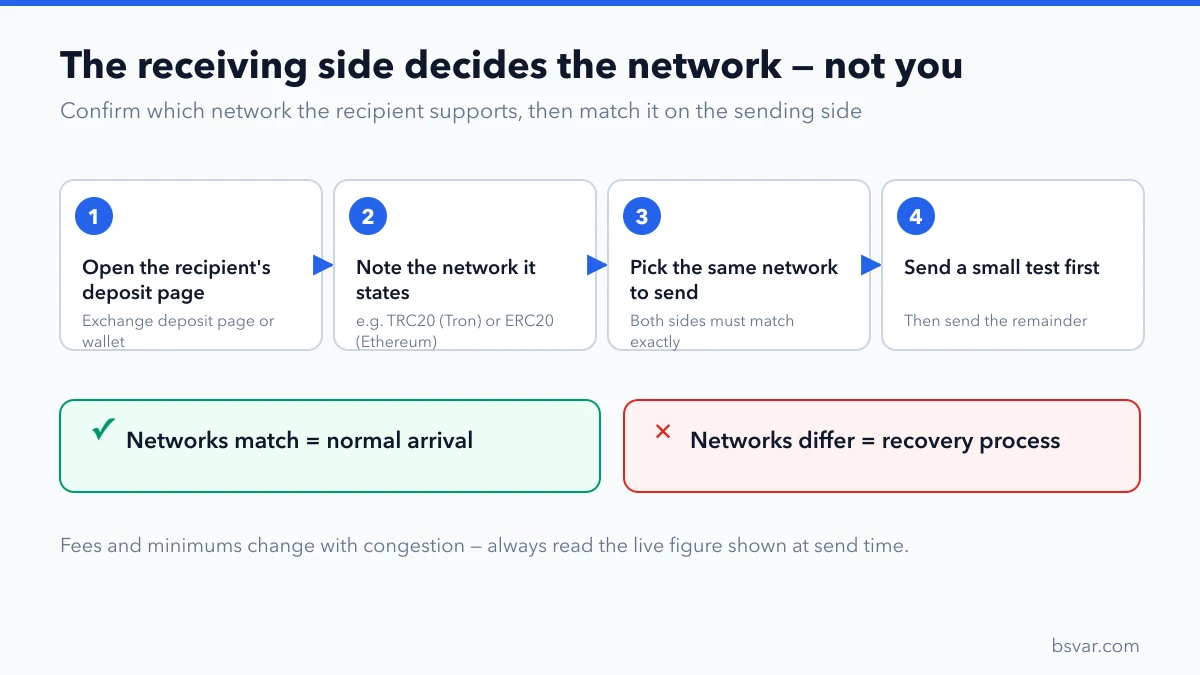
- Open the recipient's current USDT deposit or receive screen.
- Read the exact supported network — Tron (TRC20), Ethereum (ERC20), or something else entirely.
- On the sending platform, select the same asset and the same network.
- Copy the fresh deposit address. Never reuse an address you saved months ago.
- Check whether a memo or tag is required. Some destinations reject deposits sent without one.
- Review the displayed fee, the minimum withdrawal, and the expected arrival time.
- Send a small test amount first when the fee and minimum make that practical.
- Keep the transaction hash until the deposit is credited.
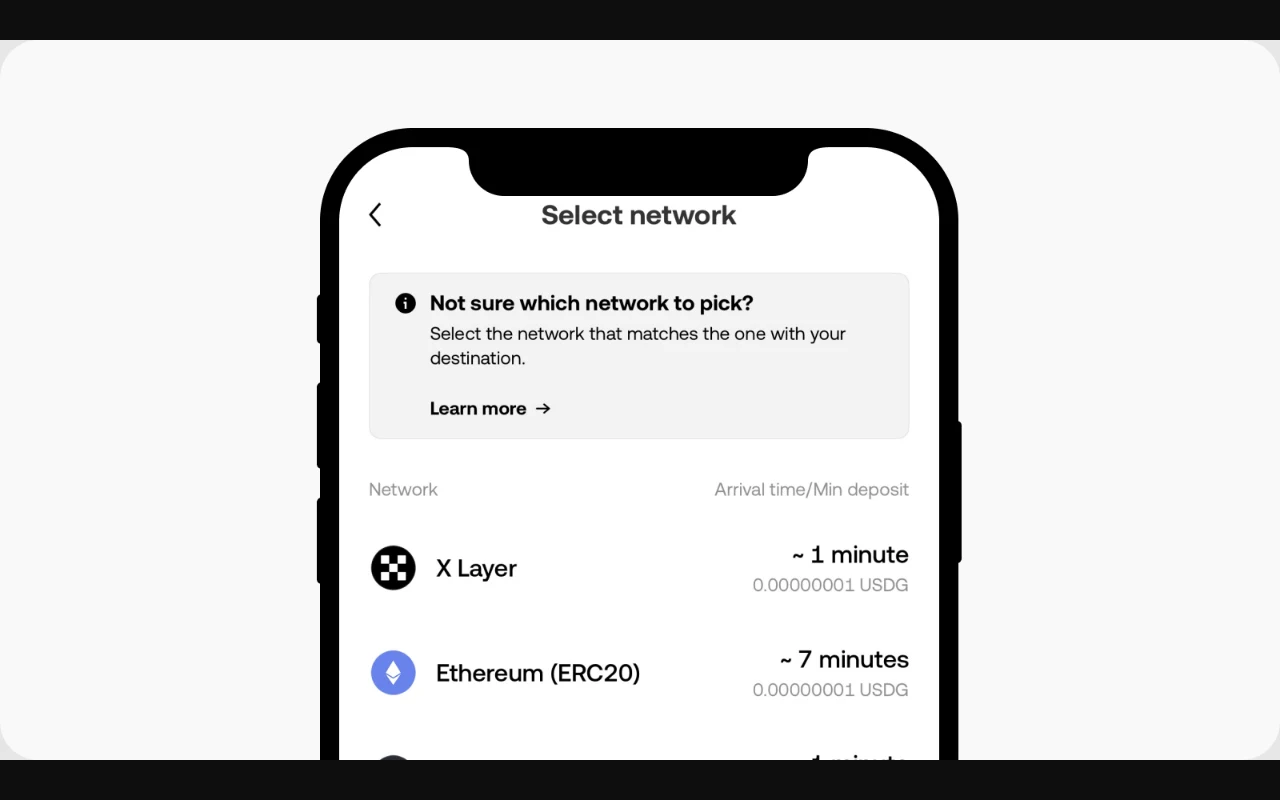
Real OKX interface screenshot from the official network-selection guide. The example asset and available networks may differ from what your account shows.
Mistakes that cost people money
- Choosing the network on the sending side first, then hunting for a matching address. Always start from the recipient.
- Trusting the address prefix. A
0xaddress could be Ethereum, BNB Smart Chain, Polygon, Arbitrum or a dozen other EVM networks. The prefix narrows it down; it does not identify the chain. - Reusing a stale deposit address. Exchanges rotate them, and a retired address may no longer credit your account.
- Sending the full amount on an untested route. A test transfer costs one fee. A wrong-network transfer can cost the whole balance.
- Ignoring the memo/tag field when the destination asks for one.
- Sending a second transaction to "fix" the first. It does not undo anything and can compound the problem.
What if you already used the wrong network?
Stop and gather facts before doing anything else. Save the transaction hash, the asset, the network you actually used, the destination address, and your platform records. Whether recovery is possible depends almost entirely on who controls the receiving address — not on how quickly you act.
Our full walkthrough is here: Sent USDT on the Wrong Network? Recovery Scenarios.
Ignore anyone who contacts you offering guaranteed recovery. A legitimate support review never requires your seed phrase, password, one-time code or remote access to your device.
FAQ
Which one should I choose, TRC20 or ERC20?
Whichever one the recipient supports. When both are supported and you are simply moving USDT between accounts, TRC20 is normally cheaper. Choose ERC20 when the destination is an Ethereum wallet or an Ethereum smart contract.
Is TRC20 USDT the same as ERC20 USDT?
They represent the same USDT unit, but they exist on different blockchains and are not directly interchangeable. Converting between them requires an exchange or a bridge that supports both.
Can I send ERC20 USDT to a TRC20 address?
No. The transfer will not arrive as intended. Do not proceed unless the receiving service explicitly confirms it supports the network you selected.
Which network is safer?
For an ordinary user the dominant risk is not the chain's security — it is selecting a network the recipient does not support. Both networks are heavily used for USDT. Match the network at both ends and the practical risk drops sharply.
Why is ERC20 sometimes so expensive?
Ethereum gas is priced by live competition for blockspace. When the network is busy, everyone pays more. This affects the network portion of the cost, on top of whatever flat fee your exchange charges.
Do I need ETH or TRX to send USDT?
In a self-custody wallet, yes — you need the network's native asset to pay the transaction fee: ETH for ERC20, TRX for TRC20. On an exchange the platform handles this and deducts a withdrawal fee instead, which is why exchange withdrawals do not require you to hold gas separately.
My transfer shows as successful but hasn't arrived. What now?
Check the transaction hash on the explorer for the network you actually used, and confirm the receiving platform's required number of confirmations. See Crypto Transfer Not Arrived? Check the TXID First.
Does the cheaper network mean lower quality USDT?
No. The token is the same claim on Tether regardless of which chain carries it. The network affects cost, speed and compatibility — not what the token represents.
Related guides
- How to Deposit USDT on OKX
- How to Deposit USDT on Binance
- Sent USDT on the Wrong Network?
- What Is USDT? Stablecoins Explained for Beginners
- What Are Gas Fees? Why They Spike and How to Save
Educational content, not financial advice. Network support, fees and account availability can change; verify the current details on the sending and receiving platforms before every transfer. See our Advertising & Commission Disclosure.