
Web3 & DeFi
What Are Gas Fees? Why They Spike and How to Save (2026)
What gas fees are, why Ethereum gas spikes, and how to save on gas.
Last updated: June 2026 · By the bsvar editorial team
Move funds or do anything on Ethereum and you'll pay a "gas fee." What is it, why does it sometimes cost a fortune, and how do you save? Here's the short version.
⚠️ Risk warning: Educational content, not investment advice. See our Disclaimer.
At a glance
What a gas fee is
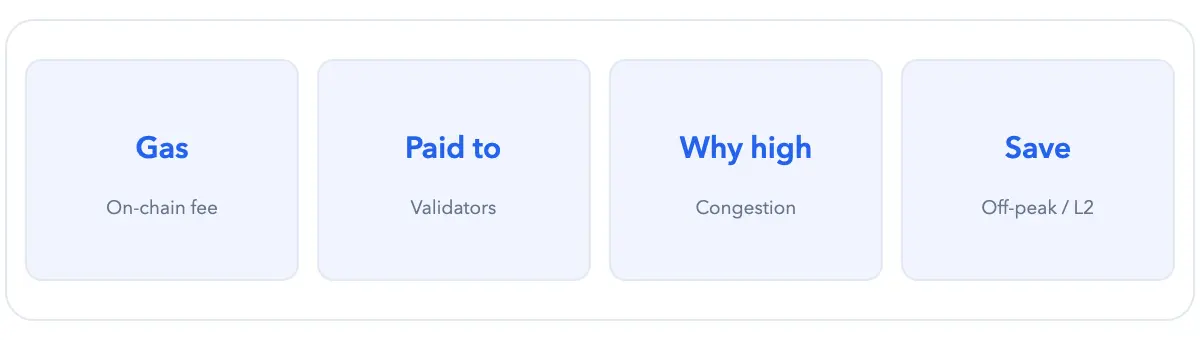
Gas is the network fee you pay to perform an action on a blockchain (most often Ethereum) — it goes to the miners/validators who maintain the network. Transfers, swaps and contract interactions all cost gas.
Why it sometimes spikes
Gas price is set by supply and demand: when the chain is congested (many people transacting at once), gas surges; when it's quiet, it's cheap. So the same transfer can cost very differently at different times.
How to save on gas
- Go off-peak — avoid busy hours;
- Use a low-fee chain — e.g. moving USDT on TRC20 is usually cheaper than Ethereum; see TRC20 vs ERC20;
- Batch actions — cut unnecessary on-chain interactions.
FAQ
Do all transfers cost gas? Every on-chain transfer has a network fee; the name and level vary by chain — Ethereum calls it gas and it's volatile. Who gets the gas fee? The miners/validators of that chain, not the exchange. Do internal exchange transfers cost gas? Transfers inside an exchange are usually free or minimal; withdrawing on-chain is what incurs the network fee.
Next steps
Estimate the fee instead of guessing
The fee is approximately gas used × (base fee + priority fee). A simple ETH transfer and a DeFi contract call require different computation, so they can cost very different amounts at the same moment. Wallets normally estimate the total, but a failed transaction can still consume gas for work already performed.
Before optimizing, ask whether the action must happen on Ethereum mainnet. If both the application and asset support a suitable layer 2, compare that route—but remember that bridges add their own risk. Ethereum.org documents the formula, typical gas usage, and layer-2 option in its official gas guide.
Content is for reference only. See our Advertising & Commission Disclosure.