
Guides
What Is a Memo or Tag? What Happens If You Forget It (2026)
A memo or tag tells an exchange which customer a deposit belongs to. Which coins need one, how to use it, and how to recover a deposit sent without it.
Published: August 2026 · By the bsvar editorial team
Short answer: a memo (also called a tag, or sometimes a note) is a short code that tells an exchange which customer a deposit belongs to. Some coins need one; most do not. If the deposit page asks for a memo and you leave it out, the transfer usually still lands on the blockchain — but the exchange cannot match it to your account, so your balance stays empty until support manually resolves it.
A missing memo is normally a recoverable problem, unlike sending on the wrong network. Do not panic, and do not send a second transaction.
Why memos exist at all
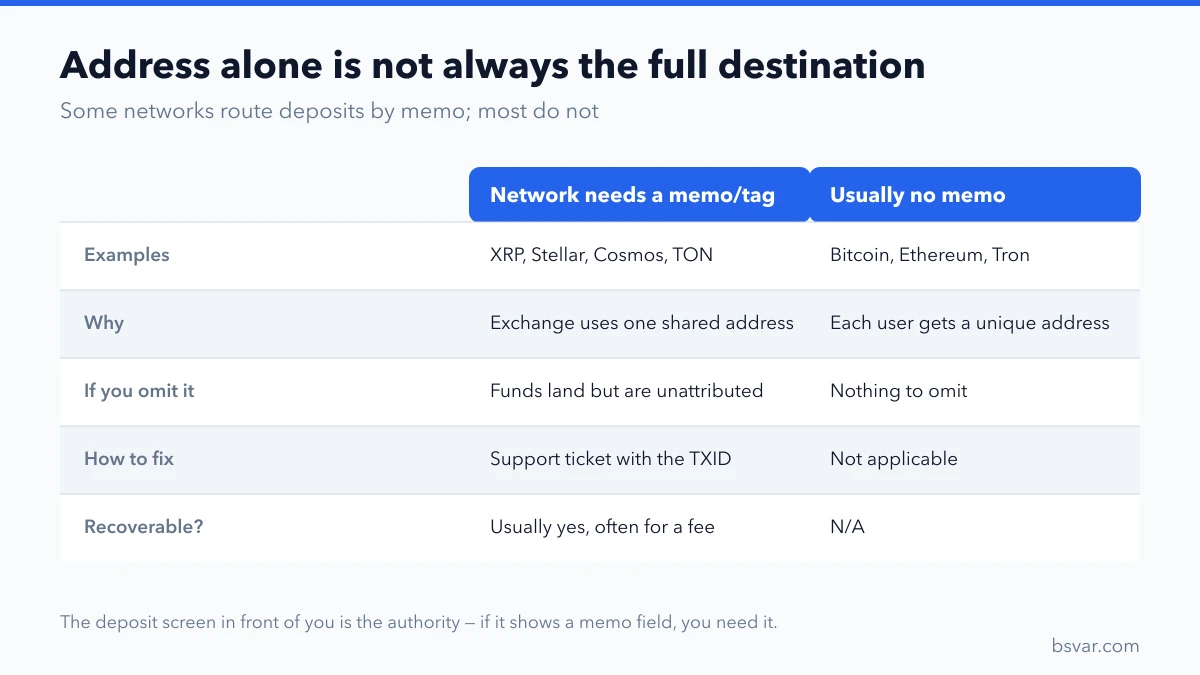
On Bitcoin or Ethereum, an exchange can afford to give every customer their own deposit address. On some other networks — XRP, Stellar, Cosmos, TON, EOS and others — that model is impractical or expensive, so the exchange holds one shared address for all of its customers on that chain.
That creates an obvious problem: if ten thousand people deposit to the same address, how does the exchange know whose money is whose? The memo is the answer. It is an identifier attached to the transaction that the exchange reads to route the funds to your specific account.
So the rule is simple: when the deposit page shows a memo field, the address alone is not enough. Address plus memo is the complete destination. Address on its own is like a correct street address with no apartment number on a building with ten thousand flats.
Which coins need one
There is no fixed list you should memorise, because it depends on the network and on the receiving platform's own setup. What is durable:
- Networks that commonly use memos or tags: XRP, Stellar (XLM), Cosmos (ATOM), TON, EOS, Hedera, and several others.
- Networks that normally do not: Bitcoin, Ethereum and other EVM chains, Tron, Solana, Litecoin.
- The deciding factor is always the deposit screen in front of you. If it displays a memo/tag field, you need it. If it does not, there is nothing to enter.
Terminology varies and means the same thing: XRP calls it a destination tag, Stellar and Cosmos call it a memo, some platforms just say note. Do not get stuck on the wording.
How to use it correctly
- Open the recipient's deposit page for the specific coin and network.
- Copy the address and the memo — they are two separate copy buttons for a reason.
- Paste both into the corresponding fields on the sending side. Never type either by hand.
- Check the memo is in the memo field, not appended to the address.
- Confirm the memo you pasted matches the one displayed, character for character.
- Send a small test amount on any new route.
One nuance worth knowing: a memo is per-account, per-platform. The memo your friend uses on the same exchange is not yours, and the memo you used last year on a different exchange is not valid here. Always read it fresh from the deposit page you are sending to right now.
What happens if you forget it
This is the common case, and it is usually fixable.
What actually happened: the transaction confirmed on-chain and the funds arrived at the exchange's shared address. They exist. What is missing is the label that tells the exchange which account to credit. That is a bookkeeping problem inside the exchange, not a lost-coins problem on the blockchain.
What to do:
- Stop. Do not send another transaction, and do not send a "memo-only" transfer hoping to correct the first one.
- Collect the evidence: the transaction hash (TXID), the coin, the network, the amount, the destination address, the timestamp, and a screenshot of the withdrawal record from the sending side.
- Open one support ticket through the official app or website of the receiving platform. Not the sending one — the receiving platform is the one holding your funds.
- State it plainly: "Deposit sent without the required memo/tag", with the TXID and the account details.
- Wait. This is a manual process. Days to a few weeks is normal. Duplicate tickets slow it down.
What to expect: most major exchanges have a defined process for this. Many charge a recovery fee, and many set a minimum value below which they will not process it. Some do not offer it at all. None of those answers is a sign of bad faith — it reflects how much manual work is involved.
What if the memo was wrong rather than missing?
If you entered a memo belonging to a different customer of the same exchange, the funds may have been credited to that person's account. The exchange can see this and, in principle, correct it — but it is a slower and more delicate process, and the outcome is not guaranteed. The ticket is still your only route.
If you sent a memo to a platform that does not use memos, nothing bad happens. The field is simply ignored.
Avoiding it next time
- Treat address and memo as a single unit. If you save deposit details, save both together.
- Copy, never type. A memo is usually a short numeric string, which makes transposing digits easy.
- Re-read the deposit page each time; platforms do change their requirements.
- Send a small test first on any new route. The fee on a test transfer is the cheapest insurance available.
- If your sending platform has an address book, store the memo in the entry rather than in a separate note.
FAQ
Is a memo the same as a destination tag?
Functionally yes. Different networks use different words for the same concept: a short identifier that routes a deposit to the right account at a shared address.
Are my coins lost if I forgot the memo?
Almost certainly not. They reached the exchange's address and exist on-chain. The issue is attribution, and it is resolved through support. This is very different from a wrong-network transfer.
How long does memo recovery take?
Typically days to several weeks, because it is handled manually. Follow the ticket status rather than any external estimate.
Will the exchange charge me?
Often, yes — a recovery fee is common, and there is frequently a minimum deposit value below which recovery is not offered. Check the receiving platform's stated policy.
Do I need a memo for USDT?
It depends entirely on the network. USDT on Tron or Ethereum does not use one. USDT issued on a memo-based network would. The deposit page is the authority.
Can I add a memo after sending?
No. The memo is part of the transaction and cannot be changed once broadcast. Support intervention is the only route.
What if my wallet has no memo field?
Then it may not support sending to that destination properly. Do not send anyway. Use a wallet or exchange that provides the field, or ask the receiving platform for an alternative deposit method.
Related guides
- TRC20 vs ERC20 USDT: Which One Should You Choose?
- Crypto Transfer Not Arrived? Check the TXID First
- Sent USDT on the Wrong Network? How to Recover It
- How to Deposit USDT on Binance
Educational content, not financial advice. Platform requirements, fees and recovery policies change; verify the current details on the receiving platform before every transfer. See our Advertising & Commission Disclosure.